Skip to content

// Regions & rate packs

TORONTO IS THE DEFAULT.
NOT THE LIMIT.

Every rate, tax percentage, statutory holdback, permit fee and code citation lives in a JSON data pack — a plain text file that ships with your source code. None of it is compiled into the engine.

That means changing jurisdiction is a data edit, not a rebuild. We ship a deep Toronto/GTA pack because that's the market we know best and it proves the depth is real. Your build gets the pack your work actually needs.

// How the knowledge is separated

The engine is jurisdiction-neutral.
The local knowledge is a named layer on top.

This isn't a claim about intent — it's how the files are laid out. ScopeGuard's scope knowledge base is indexed by CSI MasterFormat, the same taxonomy used across North America. Ontario-specific content sits in separately named fields that can be replaced without touching the requirement itself.

215

Scope requirements

Across 20 trades. Every one carries a CSI MasterFormat code — 21 divisions, from 01 General Requirements to 33 Utilities.

59

Ontario-specific references

The local_ref fields — O.Reg. 213/91, Toronto Ch. 591, excess soil rules. About a quarter of the base. Swappable line by line.

~73%

Portable as-is

Hoisting responsibility, submittal cycles, cut-and-cap, as-builts — these are disputed on every job in every country. They move with you unchanged.

// one requirement, as it ships

{
  "code": "01-020",
  "title": "Hoisting, cranage and material handling for own work",
  "csi": "01 54 00",           // portable — CSI MasterFormat
  "criticality": "high",
  "unit": "LS",
  "note": "The single most disputed item on GTA mid-rise…"  // edit per market
}

The requirement, its keywords, its criticality and its unit basis are jurisdiction-neutral. Only the note is local — and it's a string in a file you own. Retarget it to Vancouver, Chicago or Milan by editing one line.

// Anatomy of a jurisdiction pack

What actually changes between markets

The Toronto pack that ships with the AI Estimator carries every statutory number that moves a bid, each with its citation printed beside it in the output so an estimator can verify it before relying on it. Here's the full shape of the file — and what its equivalent looks like elsewhere.

Pack section Toronto / Ontario default What it becomes elsewhere
taxHST 13% (5% federal / 8% provincial), new housing rebate capped at $24,000GST+PST, state & local sales tax, or EU VAT with reverse-charge handling
labour_burdenCPP 5.95%, EI 3.22%, EHT 1.95%, WSIB rate group, vacation payFICA/FUTA/SUTA and workers' comp, or the national contributi previdenziali
construction_act10% statutory holdback, prompt-payment clock, lien preservation & perfection days, adjudicationState retainage & mechanics-lien deadlines, or the local retention regime
permits_feesBuilding permit per m², minimum fee, examination rate, construction surchargeThe municipal fee schedule wherever you build — same shape, different numbers
codeOBC reference, accessibility, energy, frost depth 1.2 m, seismicIBC + local amendments, NBC, or Eurocodes with the national annex
winterDec–Mar, heating degree days, productivity loss %, temporary heat costZero in a mild climate; larger in Winnipeg or Helsinki. Same three fields.
bonding_insurancePerformance & L&M bond %, premium, public-work threshold, CGL minimumsMiller Act thresholds in the US, or the local surety and guarantee practice
green / by-lawsToronto Green Standard v4, green roof by-law, noise Ch. 591 permitted hoursDrop the section, or replace with the local sustainability and nuisance rules
escalation_outlookAnnual material & labour %, trades under pressureYour own market read — this one you'll want to retune yearly regardless

Price catalogues are separate again

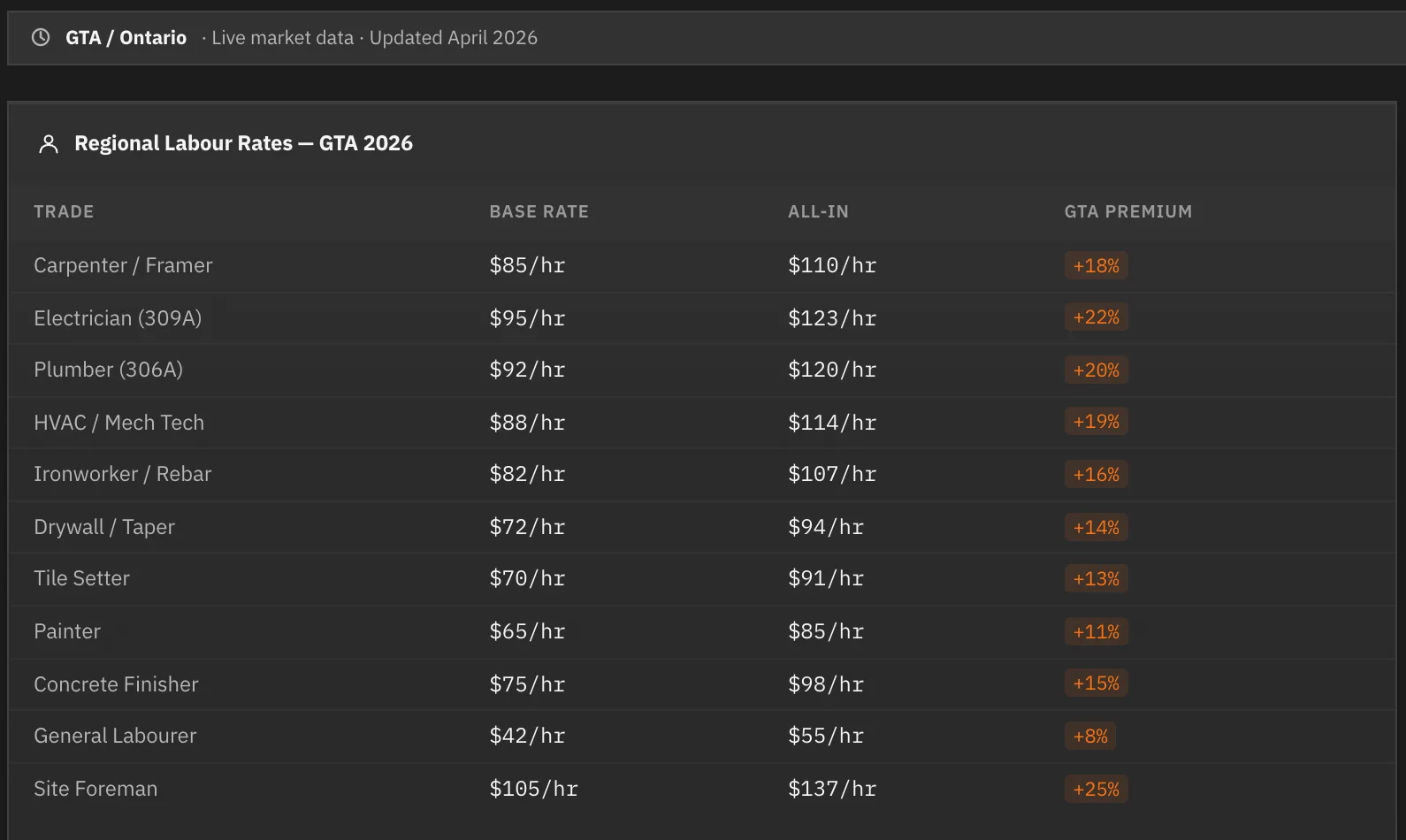
95 material items and 24 crew compositions sit in their own files, with a city cost index applied on top — material, labour, equipment and subcontract factored independently, because a remote job has near-baseline material cost and a large labour premium.

On top of that sits a user-override layer and an optional supplier feed. Your real buyout numbers beat our defaults without anyone editing the baseline.

Everything prints its source

Each statutory number carries a citation string that appears next to it in the estimate and the proposal PDF. The pack is marked verify_before_bid for a reason — these are costing inputs, not legal advice.

When you retune a pack, the citation travels with the number. Whoever reviews the bid can check it against the current source.

// Where each market actually stands

What ships built, and what gets built

We'd rather be straight about this than imply a shelf full of finished packs. The mechanism is real and in production. The depth of content varies by market.

Ships built

Toronto & GTA

The deep pack. HST and the new housing rebate, Construction Act holdback and prompt-payment timelines, Toronto building permit and examination fees, development charges, parkland dedication and community benefits charge, Toronto Green Standard v4, the green roof by-law, Ch. 591 noise hours, ravine and heritage constraints, excess soil under O.Reg. 406/19, fair wage policy, Tarion warranty, frost depth and winter productivity.

Plus a 24-city Ontario cost index with Toronto as the 1.000 baseline. This is what a jurisdiction pack looks like when it's finished.

Built in your build

Other provinces

BC, Alberta, Québec and the rest share the structure exactly — different holdback rules, lien periods, sales tax treatment and code references, same fields. The National Building Code lineage means much of the code section is a near-swap.

Québec needs the most work: CCQ labour rules and French-language documents both have real consequences for the pack.

Built in your build

United States

The easiest port, because the scope taxonomy is already CSI MasterFormat — the divisions and section numbers a US estimator already reads. What changes is statutory: retainage and mechanics-lien deadlines by state, IBC with local amendments, FICA/FUTA/SUTA and workers' comp in place of CPP/EI/WSIB, sales tax in place of HST, Miller Act thresholds for public work.

Imperial units are native already — the catalogue runs SF, LF and CY alongside metric.

Built in your build

Italy & the EU

We have a Rome office and work in the Italian market, so this isn't theoretical for us. An Italian pack means VAT with reverse charge, the prezzario regionale as the price baseline, SOA qualification categories, CCNL Edilizia labour costs, Eurocodes with the national annex, and the ritenuta a garanzia in place of statutory holdback.

Elsewhere in the EU the same pattern holds: national VAT, a local price book, Eurocodes plus annex. Documents in the working language are a model configuration question, not a code change.

Being precise about the claim

There is no region dropdown in the app and no shelf of pre-built international packs waiting to be licensed. What exists is an architecture where jurisdiction lives in data you own, a finished Toronto pack proving the depth that's achievable, and a build process that produces the pack for your market. After handover you can edit any of it yourself — that's what having the source means. If a pre-built pack for your region is what you need, we're the wrong vendor today, and we'll say so on the call.

// GCs working across provinces

Run more than one pack. The engine picks up whichever the project points at, so an Ontario job and an Alberta job price under their own rules in the same install.

// Anyone outside the GTA

The Toronto depth is the demonstration, not the constraint. Bring your own rate book to the assessment and we'll show you what it looks like loaded.

// Estimators who don't trust defaults

Good. Neither do we — the override layer exists so your real buyout numbers beat our baseline without anyone touching the catalogue.

Tell us where you build.

Bring a rate book, a recent bid, or just the jurisdiction. The assessment covers what your pack would need and how much of it already exists — before you commit to anything.

Toronto pack ships built · other jurisdictions built during your build · you own every file